I never made it to the Adelmann Mine. Fortunately, an acquaintance of mine, who happens to be an excellent photographer, did. All the present day photos were taken by Michael Maze, and are used by permission. He is a resident of Idaho, and was willing to make the 4-mile-long hike up to the Adelmann Mine to shoot these photos for me. It was a demanding hike, he later told me.
The Adelmann Mine is named after Richard Adelmann. He was born in Germany in 1846 and immigrated with his parents to New York City in 1854 when he was eight years old. After the Civil War broke out, Adelmann joined the war effort as a Union soldier and served as a drummer boy, even though he was only 16 years old. After the war, he returned to New York City and, in 1872, traveled to the Idaho Territory. For the next 20 years, Richard Adelmann ran a successful mercantile business. In 1902, he built what is now known as the Adelmann Building in Boise, which is still in use today at the corner of Idaho Street and Capitol Boulevard.
On August 23, 1907, the Idaho Daily Statesman published an article about his mining activities:
“A very interesting development has occurred on the Zephyr property, six miles out on the Idaho City road, which belongs to Richard Adelmann. The long tunnel driven to open the claim has reached the ledge, and the latter shows four feet of vein matter, much of which is ore of fair grade. Mr. Adelmann has been quietly developing the claim for a long time. Ore from near the surface carries high values in gold and silver, but it is of a smelting character and none has ever been milled.”
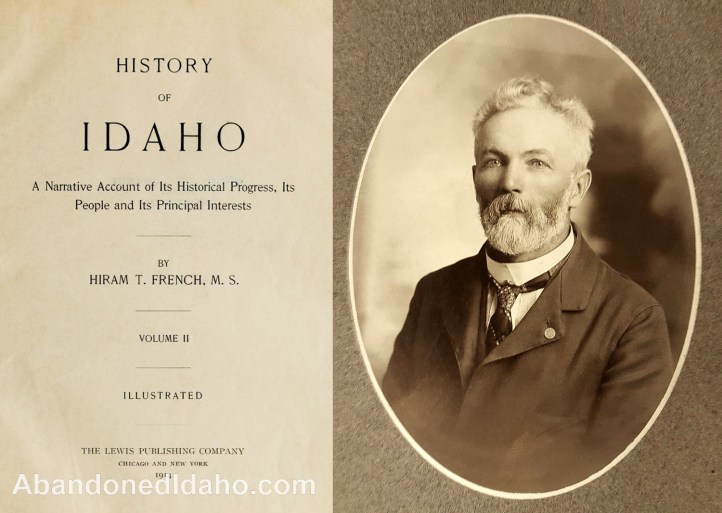
Despite this optimistic report, the Adelmann Mine and others in the Adelmann Group were not very productive and were all eventually shut down. In 1910, an authoritative history of Idaho was written, appropriately titled History of Idaho, by Hiram T. French. Richard Adelmann was considered such an important figure in Idaho’s history that he earned a place in the book. This is an excerpt from the book:
“For more than forty years Richard C. Adelmann has been identified with the business and civic life of Idaho. He is a pioneer, having come here only a few years after the first important settlement and development in this region, and for eighteen years was a resident of the old territory. Mr. Adelmann’s career has been one of varied and unusual activities, characterized by faithful and intelligent service in all capacities. He continued his education in English and German, until the outbreak of the Civil War at which time, like many other of his countrymen, he offered his services for the preservation of the Union of states. With this honorable record as a soldier, a record which gives him distinction among all American citizens, he returned to his former home in New York City. His ambitions in the meantime were directed to the great new country of the northwest. This was then a frontier community, and nearly all the resources of the surrounding countries were comprised in mining and a limited agricultural or ranching work. With his arrival at Boise, Mr. Adelmann established himself in the merchandise business and for nearly twenty years was one of the active merchants of the city. Since that time, though living retired in the main, he has followed quartz mining, and his many years of active enterprise have brought him a comfortable prosperity for his declining years.”
Public domain document and photo
This is the title page of the History of Idaho book, and Mr. Adelmann’s portrait. Richard Adelmann was such an outstanding member of the Boise community that he had the honor of being included in the book while we was still living.
Public domain photo
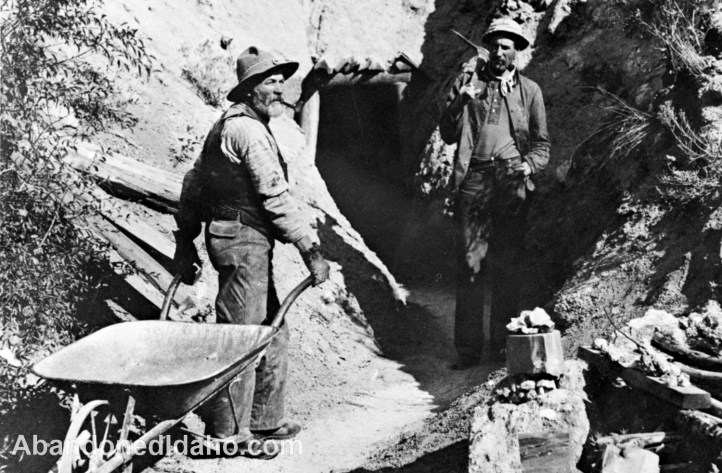
In his later years, still possessing an entrepreneurial spirit, Adelmann entered the mining business in 1892. He established several mining claims, collectively known as the Adelmann Group, just a few miles northeast of Boise. Richard Adelmann is shown with his wheelbarrow in this circa 1910 photo, hard at work at his mine.
Public domain photo
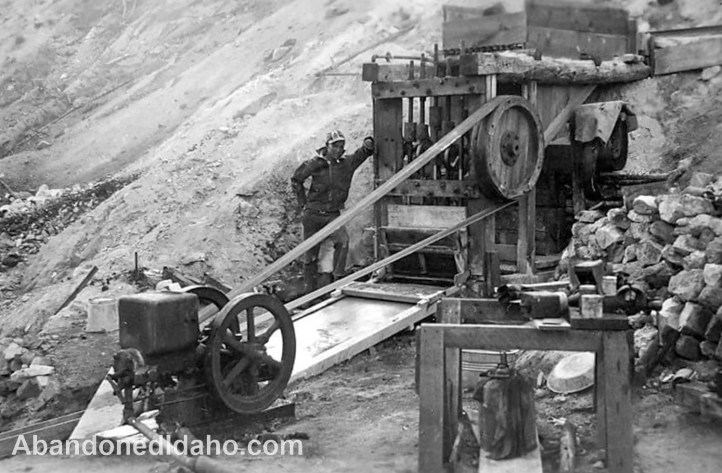
This is a small-scale stamp mill used for crushing ore, powered by a diesel or gas motor. It was located at the mine, most likely used prior to the construction of the buildings shown in the current photographs, which housed a much larger roller mill.
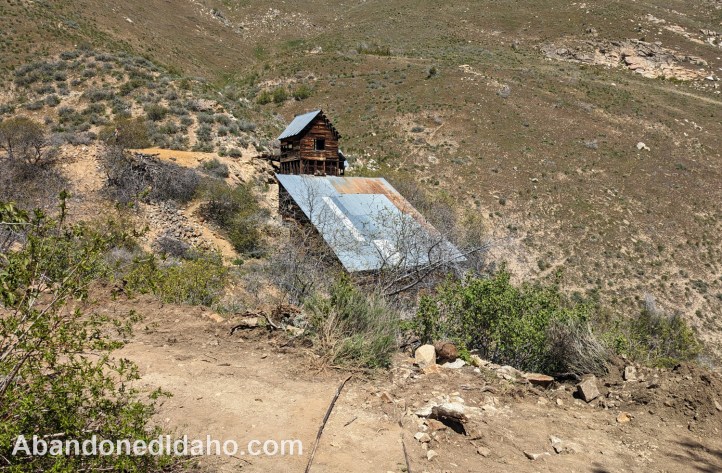
This is the trail used by Michael as he approached the mine.
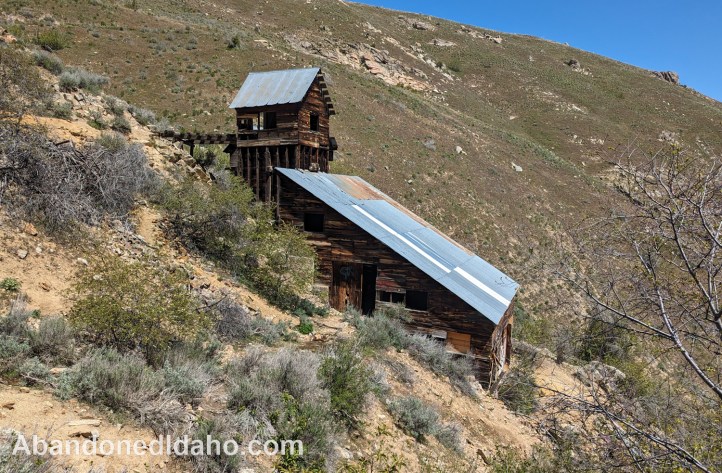
The stamp mill consisted of two sections. The upper section is where the ore cars dumped their loads. Ore was then dropped down to the lower section for processing.
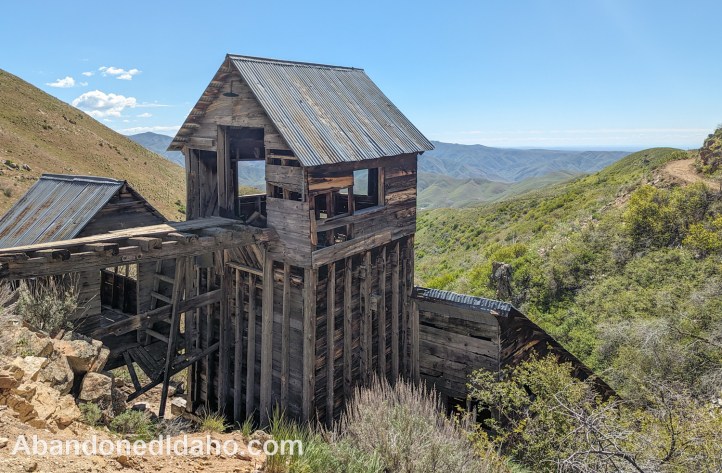
The trestle on the left once supported the tracks used by the ore carts as they exited the mine tunnel and transported the ore to the upper section of the building.
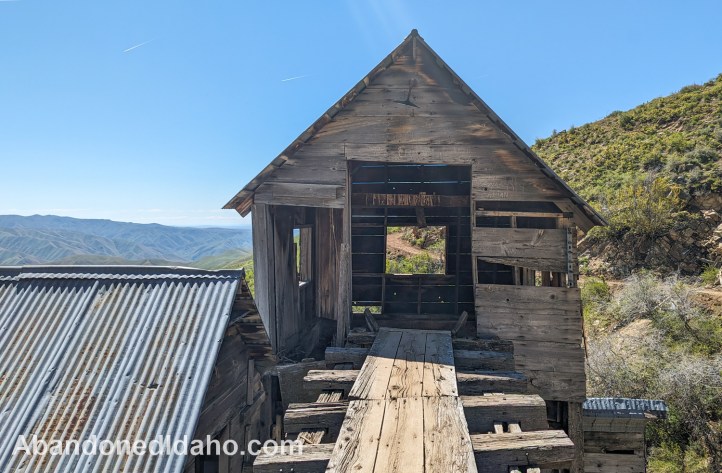
Michael decided to venture out on to the trestle. At one time tracks for the ore cars ran along these boards. The ore was dumped just inside the building and was funneled down to the lower sections for processing.
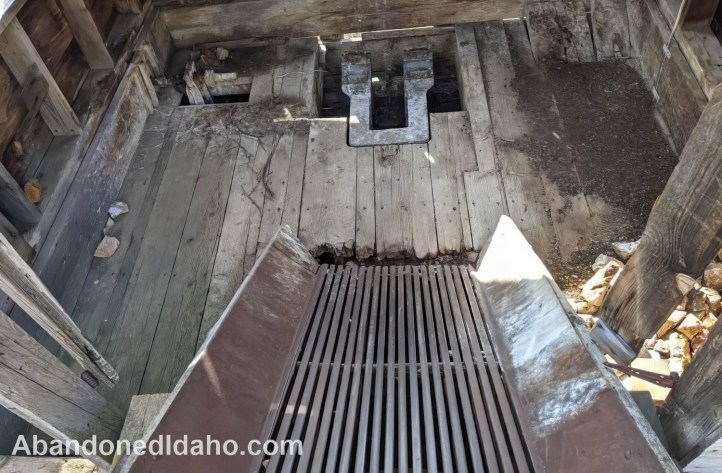
Peeking into the upper section of the mill, the chute can be seen where the ore was dumped and then guided into the hole at the top of the photograph.
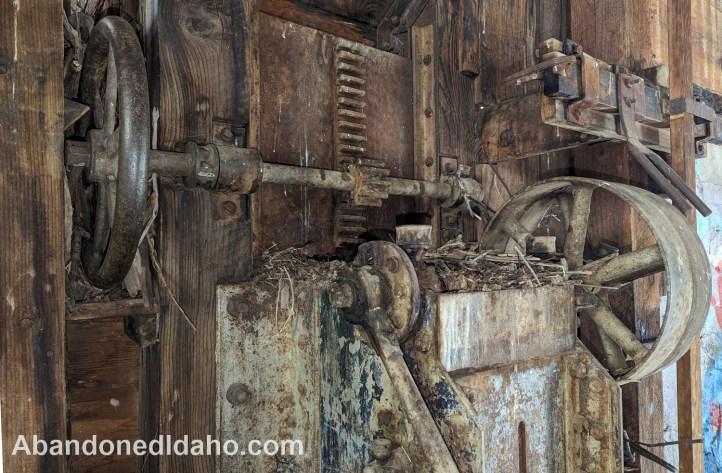
Michael ventured inside the mill. This photo was taken in the section below where the chute was located. It shows the bottom end of the ore shoot with a gate that can be raised or lowered in order to control the flow of the ore.
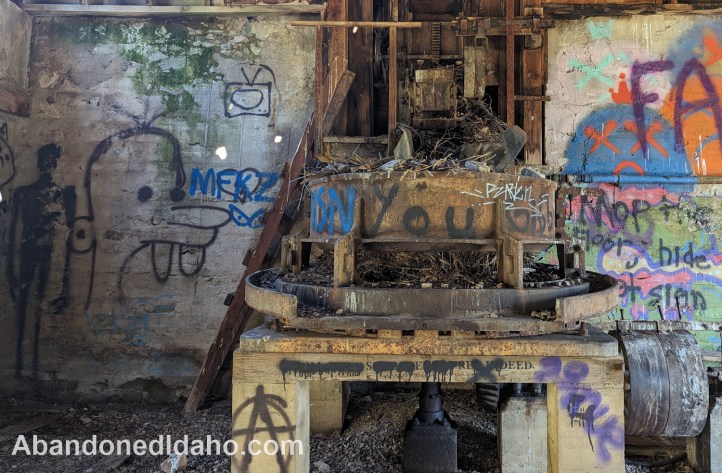
The wheels on the right were probably rotated by belts that turned the gears visible under the platform, which in turn made the mechanism in the center of the photograph rotate.
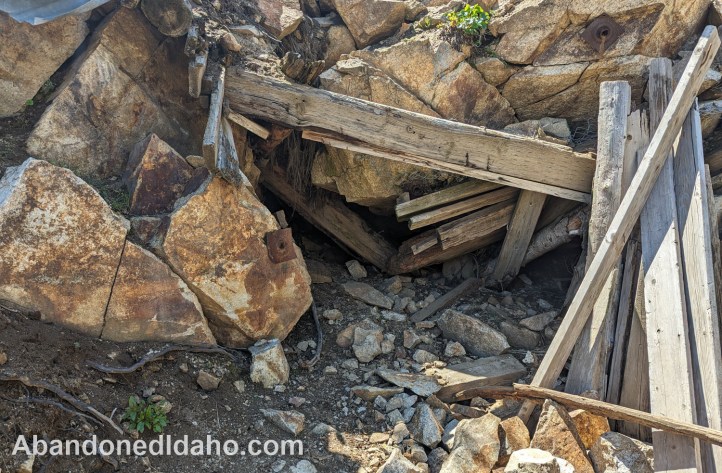
This is the entrance to the mine tunnel, which collapsed decades ago. In the 1960s it was possible to venture about 50 feet into this tunnel.
You can leave a comment by scrolling down to the very bottom of this post to where you see “Leave a comment“. Please subscribe to our blog if you would like to be notified of new posts and/or new comments.

 Abandoned Idaho
this was so informative! Thank you for the detailed photos and descriptions!
LikeLike
Very well done. BTW, the mill in the abandoned building is a roller, not stamp, mill (Allis Chalmers Co. 5 ft Huntington Mill).
LikeLike
Thanks Eric. I made the correction.
LikeLike