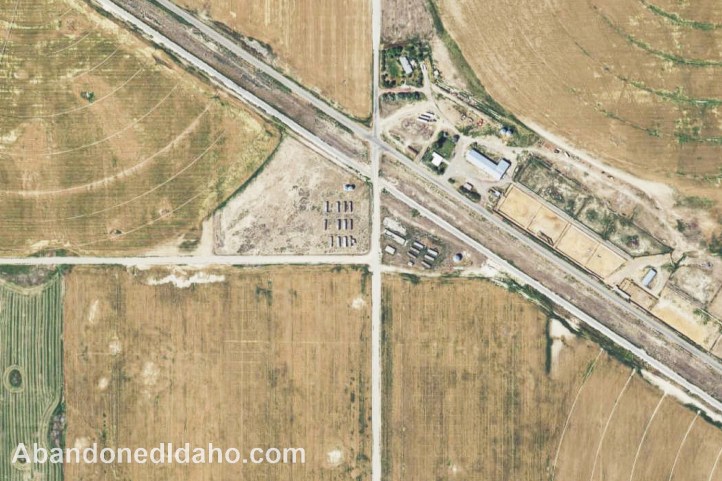
(Photo credit: Creative Commons Attribution BY 4.0, USDA-FSA Aerial Photography Field Office)
This is how I found the abandoned box cars near Fullmer, Idaho. I was searching my planned route from Blackfoot to Atomic City by following Hwy 26 on Google Earth. Hwy 26 was re-aligned a number of years ago, but the original route ran parallel to railroad tracks. Sometimes following the original route of a highway is a good way to find abandoned buildings. I noticed a group of rectangular objects in a field just off the old highway about 15 miles north west of Blackfoot. I decided I should investigate and find out what these objects were. There was never an actually town of Fullmer. It was probably just a stop along the railroad tracks.
All photos of the Fullmer Boxcars were taken by me.
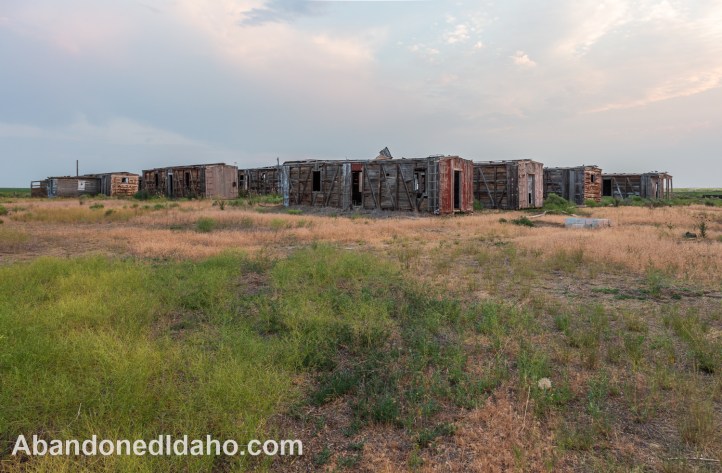
When I arrived, I confirmed my suspicion that these were boxcars. Nowadays all boxcars you see in trains are made of steel, but these were made of wood. They were likely built in the late 1890s or early 1900s. Wooden box cars were phased out by the 1950s and replaced with newer versions made with steel. I counted seventeen of them lined up in rows. What were they used for? I could not find any information about them in any of the books I have on Idaho or any Idaho based web sites, so I turned to my Facebook groups for help. I posted a photo of the boxcars and asked if anyone knew anything about them. Surprisingly, many people had first hand knowledge about them: they either knew someone who lived there or they lived in one themselves. My research concluded that they were used as housing for migrant farm workers and temporary laborers.
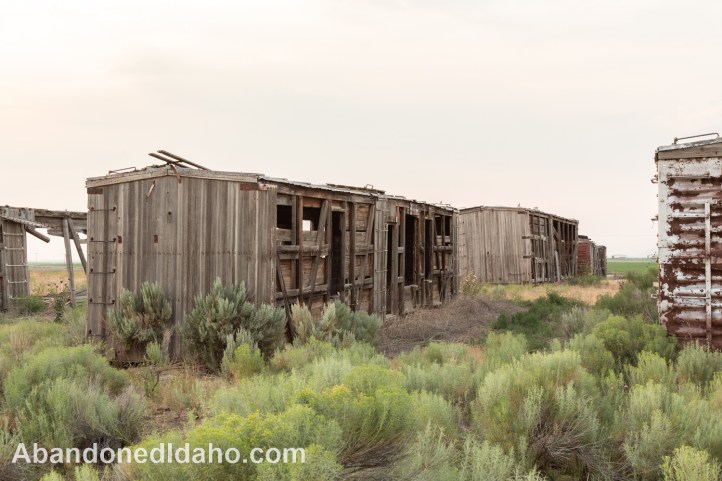
When these wooden boxcars were no longer used by the railroad they were put into storage in a rail yard in Pocatello. At some point they were moved from the Pocatello rail yard to be repurposed here as temporary housing for migrant farm workers. According to one individual that commented on my Facebook post, some of these workers traveled all the way from Texas to Idaho to weed fields, hoe sugar beet fields, and work the harvests.
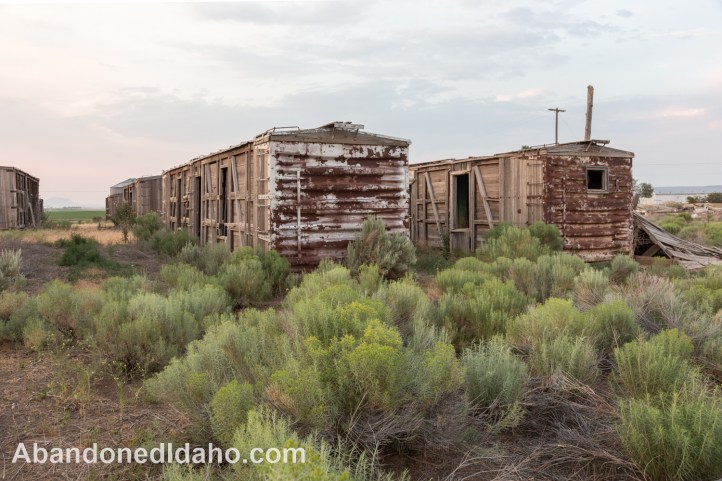
Some locals referred to the area as the “Tabor Labor Camp”, while others called it “Mexico City”. The boxcars were still in use through the 1960s. Each boxcar had an electrical hookup but no plumbing. Living conditions for the farm workers must have been pretty harsh. One individual who stayed there for a week in the summer of 1964 remembers small tables, a few chairs, and dirty mattresses as the only furnishings. He had to sleep in a sleeping bag.
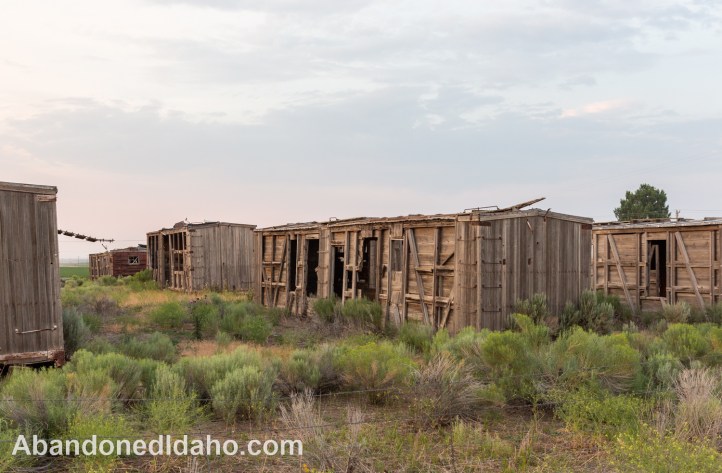
The box cars were constructed with wood framing that had horizontal boards on the interior and vertical boards on the exterior. Much of the wood has been salvaged. I found three that had steel end walls, and two of those had windows cut out of them.
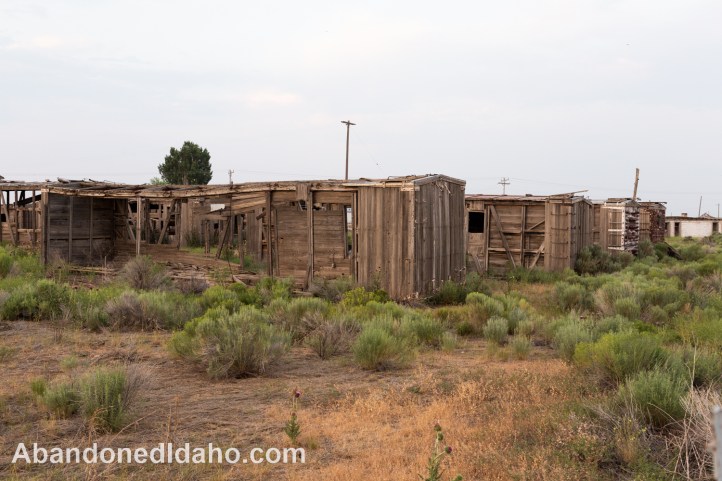
These box cars were abandoned twice: first by the railroad that no longer could use them, and again by the farm owners, probably due to their deteriorating condition. Most had windows cut into the side walls.
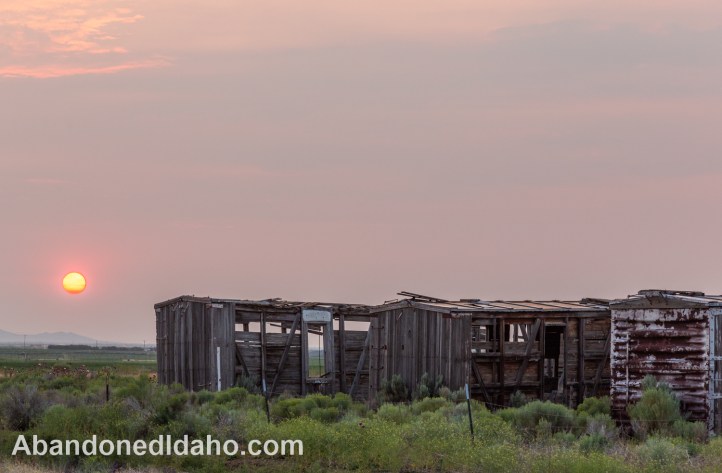
I was planning to check out a large abandoned warehouse located a mile further along the old highway but it was getting dark, so I decided to stick around and get a shot of the sun setting behind the box cars.
You can leave a comment by scrolling down to the very bottom of this post to where you see “Leave a comment“. Please subscribe to our blog if you would like to be notified of new posts and/or new comments.


 Abandoned Idaho
Very interesting post. Thanks for the info.
LikeLike
I found these was by searching through the area using Google Earth. I usually scan along my proposed routes of my road trips looking for anything interesting. I found a series of dark rectangles arranged in rows but I could not tell what they were. Upon my arrival I discovered that they were abandoned boxcars.
LikeLike