
Atlanta was named by Southern sympathizers who mistakenly believed that the Confederacy had won the Battle of Atlanta, Georgia, during the Civil war. This turned out to be false, but the name stuck. A “lode” is a vein of ore containing gold and silver formed between two layers of harder rock, such as granite. The Atlanta Lode was 1.5 miles long and varied between 15 and 30 feet thick. A lode this huge was considered to be a “mother lode”. All historical photos are in the public domain. All present-day photos were taken by Michael Maze, used by permission.

The history of Atlanta is closely tied to the history of mining. In 1863, a prospector named John Stanley discovered placer gold in the Yuba River at the base of the rugged Sawtooth Mountain Range in central Idaho. He tried to keep it a secret, but other prospectors soon heard about it, sparking a small gold rush. However, the other prospectors who arrived later and worked nearby rivers had little success and eventually moved on. They all missed the mother lode because they all focused their efforts on panning in the rives and creeks. The Atlanta motherlode was a vein of rich ore on the side of a mountain, and the only way to get the ore was by digging with a pick and shovel.
In 1876, Atlanta’s population peaked at around 500. By 1909, it had declined to 110 and by 1960, it was down to just fifty people. This photo of Atlanta, likely from the 1890s, is one of the earliest photos of the town.

The 150-ton-per-day capacity Monarch Mill is seen here around 1907. Ore from the Monarch Mine was delivered to the mill via an aerial tramway coming down from the hill on the right. Stamp mills pounded the ore with heavy metal stamps weighing 400 lbs. or more. These were raised and lowered to crush the ore until it reached the consistency of sand. They ran twenty-four hours a day. The noise was deafening.
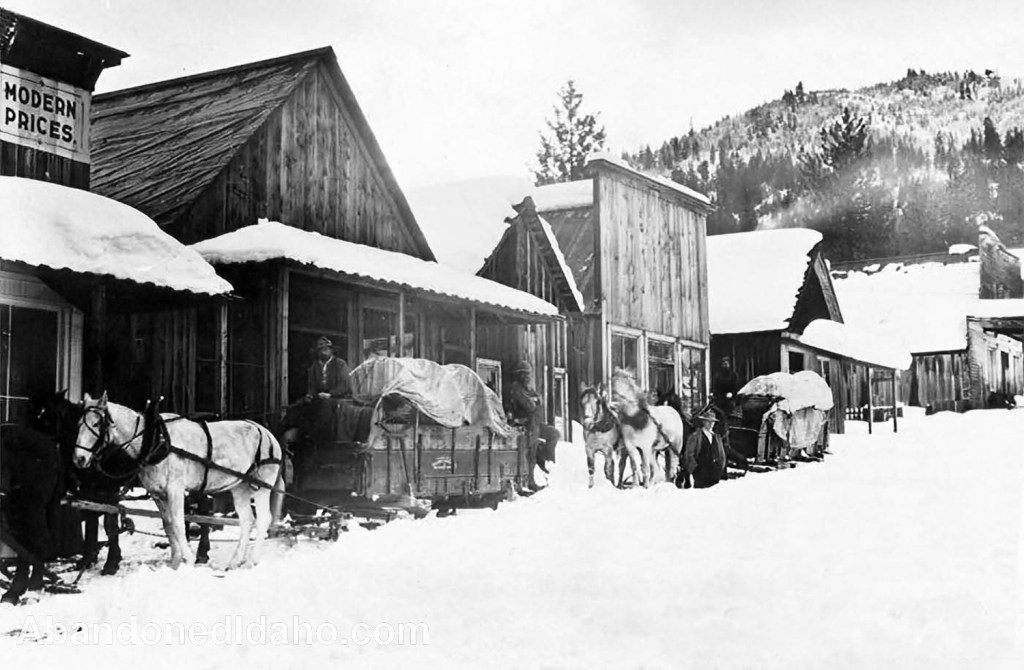
For many years, the only means of transporting equipment and supplies to Atlanta was via horse-drawn wagon from Rocky Bar over a mountain pass 7,800 feet high. In the winter, operators switched to horse-drawn freight wagon.
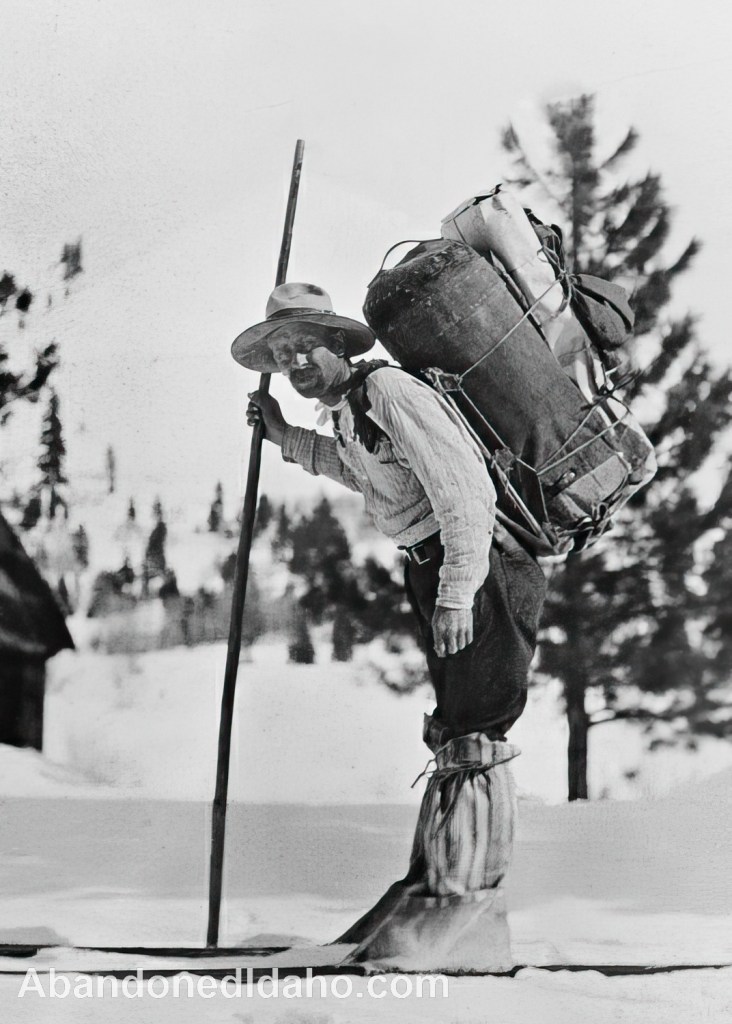
This is Frank Stevens in 1920 with an 80-lb. sack of mail. He was a mail carrier on the route between Rocky Bar and Atlanta, a 15-mile trip over a mountain pass 7,800 feet high. Between 1892 and 1913, seven mail carriers lost their lives on this route due to avalanches. This was one of the most dangerous mail routes in the country.

Almost all of the surviving structures in Atlanta were built with either corrugated metal or a sheet metal roofs. Few other structures remain, and reportedly a few people live in Atlanta.

At one time, this was Atlanta’s jail, which for some reason was built over a small creek. There were two cells in the back and a small table in the front room.

When the high-grade ore ran out and operations were no longer profitable, Atlanta experienced a financial collapse as mine owners could no longer pay their creditors. Mining operations shut down again, this time for about twenty years. It was not until 1936 that the first road was built from Boise to Atlanta, and the refractory problem was finally solved. Production ultimately ended in 1953. Despite all the setbacks, the overall production of the Atlanta area mines was about $18 million in gold and silver.

 Abandoned Idaho