
Burke is one of the ghost towns featured in my book, Ghost Towns of Western Idaho. It’s easy to find if you want to see it for yourself. From I-90 in Idaho, take the Wallace exit and then go northeast on Hwy 4 for 7 miles to Burke.
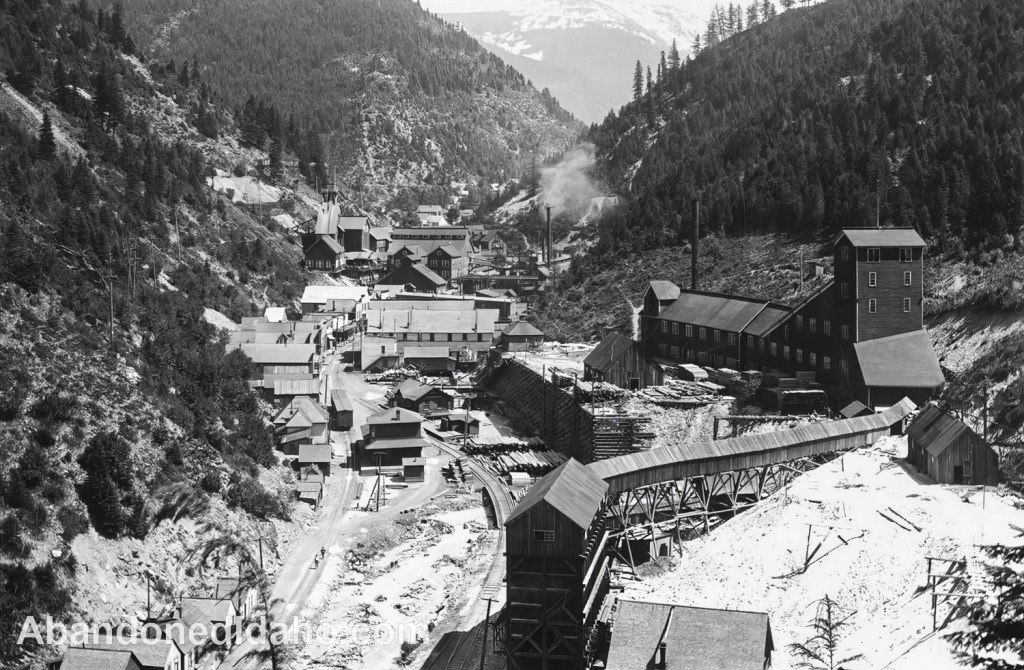
Burke was a true mining town, created solely to support the multiple mining operations in Burke Canyon. It was just one of several mining towns in this Idaho panhandle canyon. In 1884, significant deposits of silver, lead, and zinc were discovered in Burke Canyon. The first miners and settlers arrived shortly afterward. By 1885, so much ore was being produced that the owners of the Tiger Mine decided to build their own narrow-gauge railroad just to haul ore out of the canyon. The 3-foot-wide Canyon Creek narrow-gauge railroad was completed in 1887. By that time, the Tiger Mine employed about 100 miners, while the Poorman Mine on the opposite side of the canyon employed around seventy. The mining town of Burke was officially established that same year. By 1891, the Poorman Mine was processing the largest amount of ore. This photo shows Burke in the late 1800s.
Public domain photo
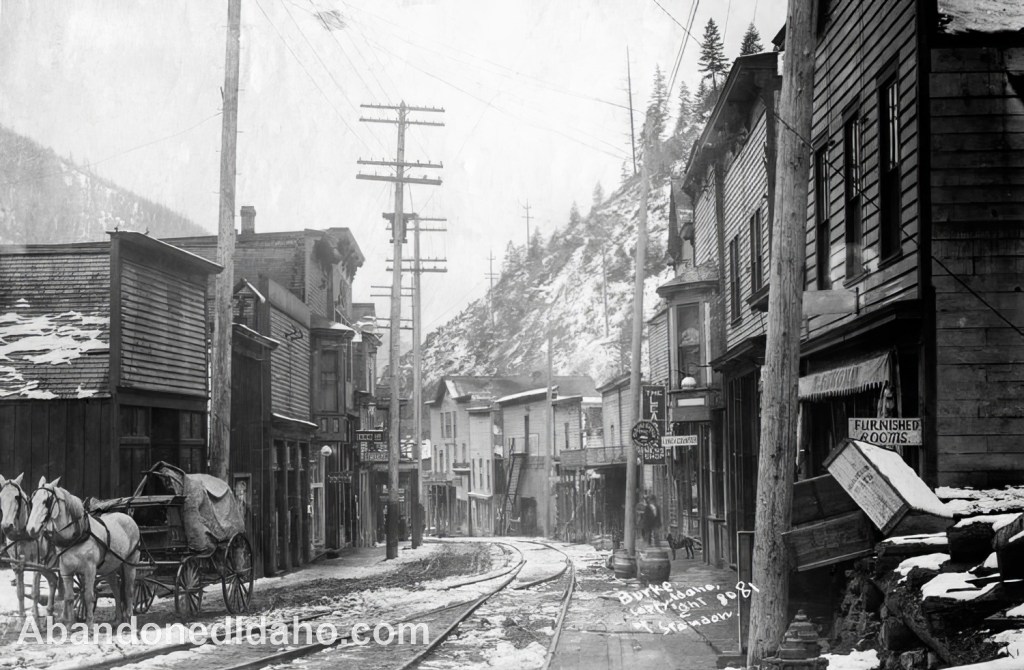
The Northern Pacific Railroad also built a rail line through Burke Canyon, but the canyon’s narrow width—just 300 feet in some areas—presented challenges. The railroad tracks had to be laid directly on Burke’s main street, forcing cars and trains to share the cramped passageway. On occasion, a visitor parked too close to the tracks, requiring the locomotive engineer to stop the train and find the car’s owner to tell them to move it.

Public domain photo
The Tiger Mine employed about 300 workers at its peak and had the unusual practice of hiring only unmarried men. The 150-room company-owned Tiger Hotel, built in 1896 as a boarding house for miners, was constructed directly over Canyon Creek due to the scarcity of buildable land in the narrow valley. In 1906, when the railroad expanded through Burke, tracks were laid right through the hotel’s lobby. Hotel guests often saw as many as five trains a day pass through. It was believed that the Tiger Hotel was the only hotel in the world with trains passing through its lobby. The hotel became unprofitable in the 1940s and was finally torn down in 1954.
Public domain photo
The mine structures were rebuilt with brick, concrete, and steel, and these remain to this day as the only surviving mining structures in Burke Canyon. All other mine structures in the canyon have been torn down. By far the most imposing remaining structure is the mammoth concrete ore storage bin of the Hecla Mine.

Burke’s population peaked in 1910, with about 1,400 residents and over 150 buildings. Today, only about a dozen residents and as many buildings remain, many of which are abandoned.

Photo credit: @davidegg22 via YouTube
The white arrow on the photo above points to the same building as shown in the photo below.

Photo credit: Patrick McManus

 Abandoned Idaho