Prior to my trip to Silver City, I did some research online and I was able to locate quite a few historical photos of the city. Good sources of public domain photos are Wikimedia Commons, The Library of Congress, and the digital photo collections of the University of Idaho and Boise State University. Many of the photos were rather poor quality, but I was able to enhance them to some degree. All historical photos of Silver City shown here are in the public domain. In fact, any photo published prior to 1929 is now in the public domain. My sources for historical information were primarily the books that I have listed in my Book Reviews page.
The story of Silver City begins in 1863, when a group of twenty-nine prospectors known as the Jordan Party searched the Owyhee Mountains for the so-called Blue Bucket Mine, supposedly located in Oregon. However, the men were on the wrong trail and mistakenly believed they were in Oregon, though they were actually in the extreme southwestern corner of Idaho Territory. They were still over 20 miles away from the Oregon border. As a result, they never found the mine. Fortunately, their disorientation led them to discover something even better: an abundance of gold in Jordan Creek. One of the men described their discovery as follows:
“One of our inquisitive spirits carelessly scooped up a shovelful of gravel and ‘panning it out’ —found about a hundred ‘colors’ … Picks and shovels were wielded with telling strokes among the slumbering rocks, gravel and soil. When near bed-rock, was seen, in pleasing quantities, the idol of avarice, the master of men, and the seductive and winning creature of women—GOLD.”
Placer mining (also known as “panning”) for gold was productive, but it lasted only one year before the gold ran out. The following year, large silver deposits were discovered. It was silver, not gold, that triggered the massive mining boom and the establishment of Silver City.
The population peaked at around 2,500 residents. However, in true mining-town boom-and-bust tradition, by 1912, mining operations ceased, and Silver City began its decline to ghost town status. In the 1930s, it was taken off the power grid and lost the county seat to the town of Murphy. By the 1940s and into the 1950s, Silver City had only one permanent resident: Willie Hawes. He served as the mayor, police chief, postman, councilman, dog catcher, and caretaker. Over its history, Silver City’s mines produced about $60 million worth of ore.
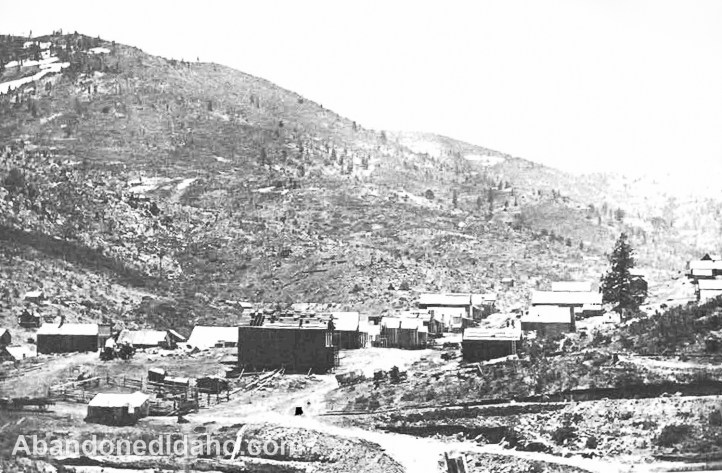
Silver City was just a small clump of buildings as shown in this photo from 1866. This is one of the earliest known photos of Silver City, just 3 years after the Jordan Party discovered gold in Jordan Creek.

In 2 years Silver City had grown substantially, as seen in this photo from 1868. War Eagle Mountain is in the background. Several mining claims were located just above Silver City on War Eagle Mountain, including one operated as the Hays and Ray Mine. In 1865, newcomer D.C. Bryan discovered a silver vein on War Eagle Mountain, filed a claim, and named his mine Poorman.
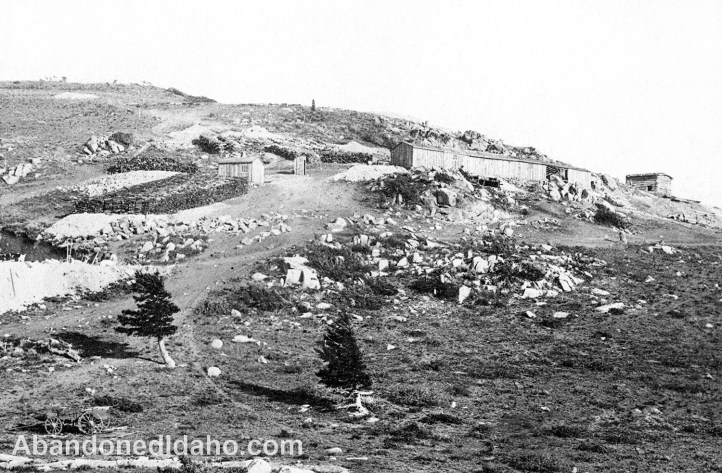
This is the Poorman Mine started by D.C. Bryan in 1865, way too close to the Hays and Ray Mine. Whether or not Bryan did this deliberately remains a mystery. The owners of Hays and Ray believed (correctly) that the silver ore vein under Poorman was actually part of the vein under their claim. A court battle ensued, but both sides refused to give up their claim to the same silver ore vein, which contained an incredible 80% gold and silver. The dispute turned violent in September 1865 when miners began shooting at each other. The Poorman miners even built a log fort above their mine entrance for defense. Eventually, the court ruled in favor of Hays and Ray, forcing the Poorman to shut down, but not before it had extracted $500,000 worth of ore from the Hays and Ray vein.
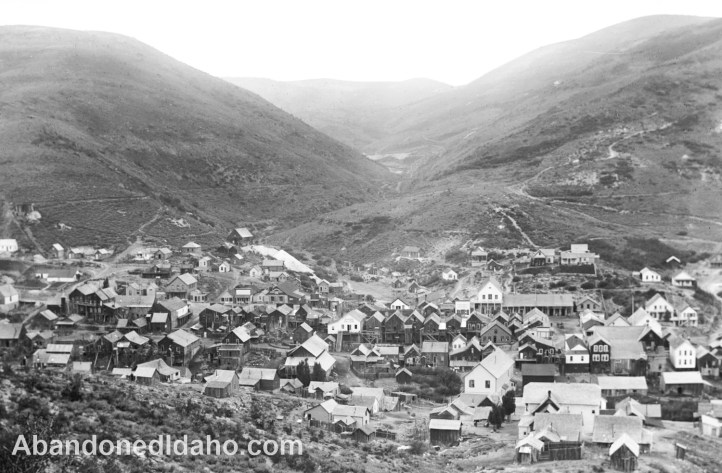
This is Silver City as seen from a viewpoint above town looking southwest. In 1868, another dispute arose between two mine owners when miners from the Golden Chariot Mine broke into a tunnel owned by the Ida Elmore Mine. An underground battle erupted as miners from each side armed themselves and started shooting at each other deep in the tunnels. Two miners were killed and many more were injured by the heavy gunfire. The situation worsened when both sides hired gunmen, escalating the violence. At one point at least one hundred armed men occupied the tunnels. The sheriff was powerless to stop the violence, though he did order all the saloons in town to close. The governor had to intervene and sent a deputy marshal with a proclamation demanding that the fighting cease. The deputy met with the leaders of the two companies, formal deeds were drawn, and the matter seemed settled. The saloons reopened, but a few days later, a drunken brawl broke out between the two groups of miners. One miner from the Ida Elmore was injured, and his friends, seeking revenge, organized a lynch mob to attack the Golden Chariot miners. With a crisis looming, the governor ordered ninety-five soldiers with a cannon to the area. The military occupied the city, but it took four more days before hostilities finally ceased.

This photo was taken in 1907, from the opposite side of the valley as compared to the previous photo. Mining operations ended 5 years after this photo was taken. Silver City mines were productive for almost 50 years.

The US Geological Survey map titled Geology of Silver City and Vicinity, Idaho from 1898 reveals an abundance of gold and silver ore veins, shown in orange. Silver City was built directly on one of them. This explains why there are mine shafts and portals within the city itself. It has been reported that underneath the Idaho Hotel there is an entrance to a tunnel that leads to one of the abandoned mines. Dewey was another mining town located just down the road from Silver City, but nothing of it remains.
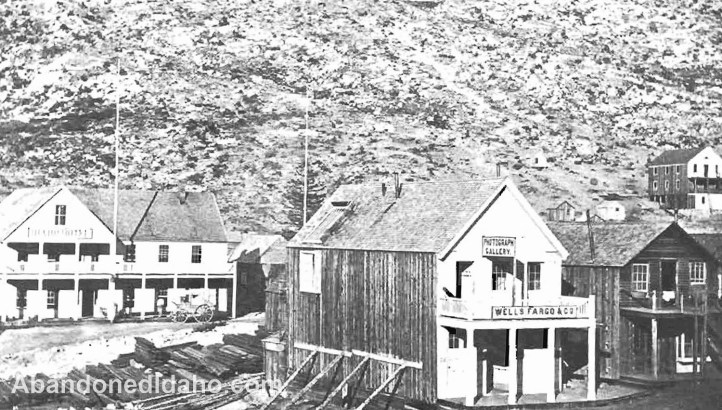
The Idaho Hotel on the left was “assembled” in 1866. This is because it was first built in Ruby City, a nearby mining town. Ruby City proved to be a poor location for a mining town, and as it declined, Silver City rose in prominence. The Idaho Hotel in Ruby City was disassembled and moved piece by piece to Silver City, along with several other buildings, where they were all reassembled.
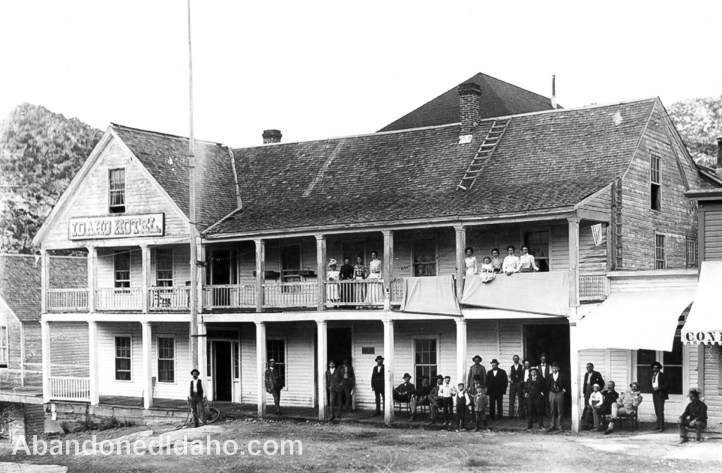
Frank Blackinger managed the Idaho Hotel from 1889 to 1899, until he married a Silver City schoolteacher and moved away to Boise. Unlike the War Eagle Hotel, owned by his father, the Idaho Hotel still stands.

Frank Blackinger’s father, Valentine, owned the War Eagle Hotel from 1869 to 1878. Despite its violent history, the 250 mines around Silver City were extremely productive. When I visited Silver City all I could find of the War Eagle Hotel property was just a vacant lot with nothing but weeds. No trace of this building remains.
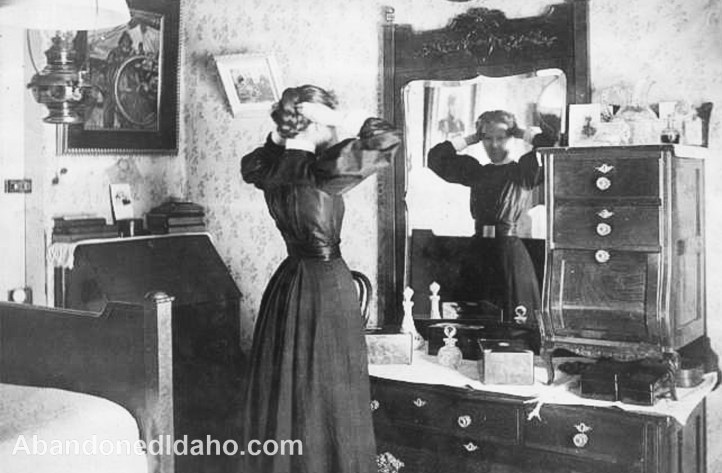
In spite of the rough and tumble life in Silver City, some of the more well-to-do citizens at least had a taste of the finer things in life. Two bottles of perfume are visible on her dresser. By the late 1860s, mine production exceeded $1 million annually. Life became more stable in the 1870s as Silver City built a courthouse, twelve stamp mills, and over seventy businesses. These included Idaho’s first newspaper, the Owyhee Avalanche, first published in 1874, six general stores, two meat markets, two hotels, four restaurants (including one Chinese restaurant), three barber shops, four lawyers, two doctors, eight saloons, numerous brothels, and around 300 homes. Silver City was even the Owyhee County Seat.
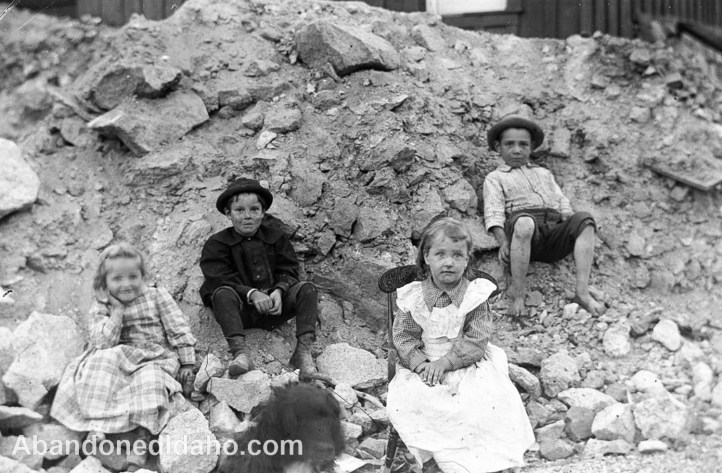
Silver City was not too kid friendly. These four youngsters found themselves on a pile of waste rock from a nearby mine. At least the boys had hats and the girls had dresses, and most of them had shoes.
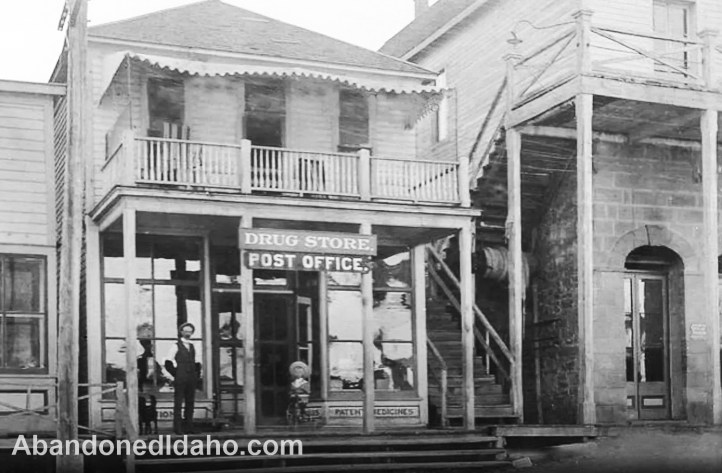
The Getchel Drug Store also served at the Silver City Post Office. Perhaps the little boy was wearing the cowboy hat his father just bought for him at the drug store. The stone building on the right is the courthouse. This building has survived over the years and can still be seen today. Nothing remains of the courthouse on the right but a few stone columns.
For present day photos from my road trip see the Silver City blog post.
You can leave a comment by scrolling down to the very bottom of this post to where you see “Leave a comment“. Please subscribe to our blog if you would like to be notified of new posts and/or new comments.

 Abandoned Idaho