The Gold Point Mine was part of a major mining boom in the Elk City area during the 1930s. Established next to the mine was the Gold Point Mining Camp built for the mine’s employees. This was a really late start compared to other mining booms in Idaho, which began 60 years earlier. Gold was discovered along the Red River, south of Elk City, where several hard rock and placer mines were developed.
The man primarily responsible for the development and management of Gold Point Mine and the mining camp was Robert White of Seattle. Like many entrepreneurs of his time, he was a strong promoter of gold mining. Originally a logger in Washington State, he yearned for bigger and better things. White generated publicity in local newspapers and even put a 50-lb. chunk of ore on display at the Cottingham Hotel in Elk City. Gold Point Mines was incorporated in 1935, and the company built its mill in 1936.
Robert White was a real go-getter and sold many shares of his new company to people he knew in Washington. In fact, he persuaded Clarence Van Scotter to sell his gasoline station in Seattle and move to Idaho.
Clarence, Mary, and their six children spent their first winter at the Gold Point Mining Camp living in a tent, while Robert and his wife lived in the camp cookhouse. It must have been quite an ordeal for Mary to keep her six children occupied and warm in a tent surrounded by snow for an entire winter. Fortunately, the following winter, the Whites returned to Seattle to attract more investors, and the Van Scotter family moved into the cookhouse.
All photographs were taken by Michael Maze, and are used by permission.

The largest building in the Gold Point Mining Camp cookhouse. The second largest building is a storage shed. All the rest of the structures in the mining camp have not withstood the tests of time.

The mining camp is situated next to a pleasant grass-covered meadow. The Red River is located on the other side of the meadow.
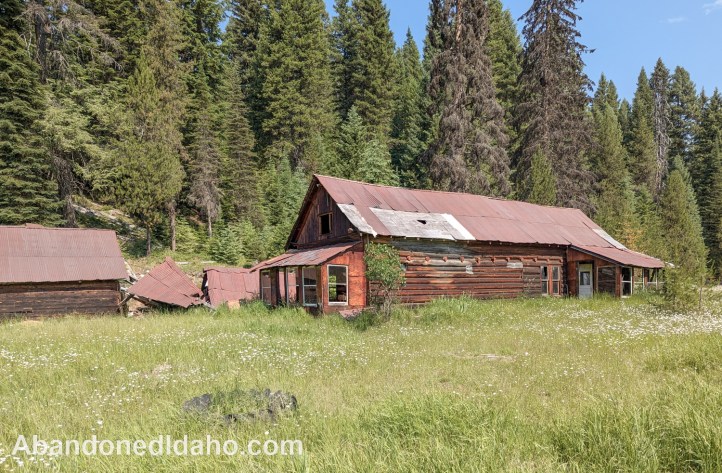
Clarence and his wife Mary packed up their six children, and drove 500 miles to the mill site, which was in pretty much in the middle of nowhere. His job was to help with the construction of the mill. This is the cookhouse where Robert White and his wife lived during the winter of 1935 to 1936 while Clarence Van Scotter and his wife Mary and their six children were forced to live in a tent.

The following winter the Van Scotter family moved out of their tent and into the cookhouse, only because the Robert White and his wife had left.
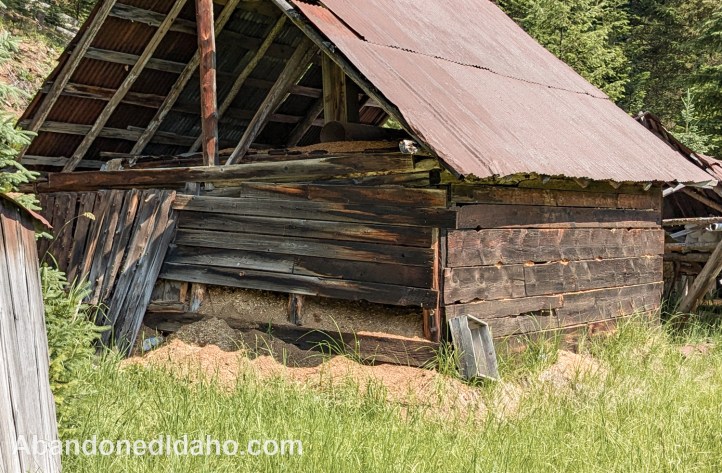
It looks like this storage shed is filled with sawdust, which was used as a fuel for the steam boilers used at the mill.

This is the main room on the first floor of the cookhouse. The chest freezers are still here. The stairs led to rooms on the second floor where some employees lived during the 1930s before the mill shut down.
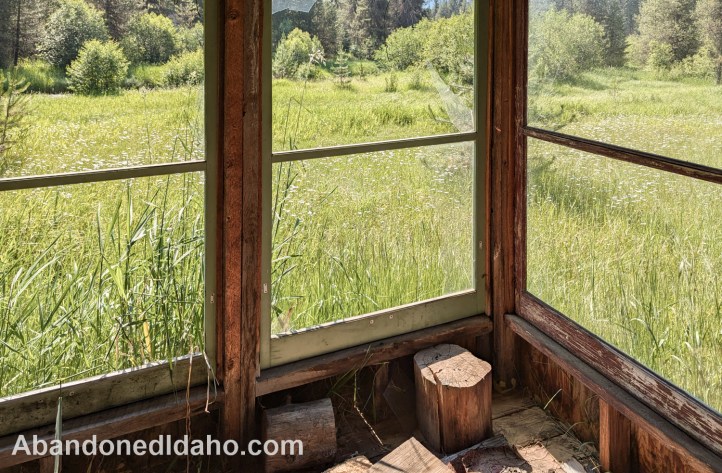
The view from the front windows of the cookhouse was very pleasant during the spring and summer months.

In the winter of 1936 to 1937, Mary stood in front of this very stove cooking dinner for Clarence and their six kids. I hope that Mary was allowed to use the stove during the previous winter while her family lived in the tent.

This is another view of the main room on the first floor. It looks like it had carpeting, which was a luxury in those days.
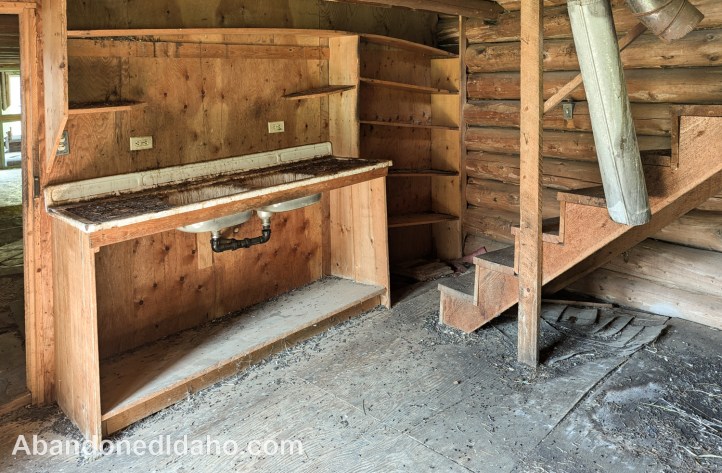
Electrical outlets are not something usually found in the abandoned buildings of mining camps, so these must have been installed towards the end of the mining camps existence in the 1930s. Faucets were never installed which means the residents would have to get water from the nearby river.

This is another example of what is known as a “dry sink”. It had a drain but was not supplied with running water.

At one time this was a double bed. It was found in one of the second floor rooms of the cookhouse.
You can leave a comment by scrolling down to the very bottom of this post to where you see “Leave a comment“. Please subscribe to our blog if you would like to be notified of new posts and/or new comments.

 Abandoned Idaho